
Welcome to Year 6
Welcome to Year 6 at Mary Exton Primary School. Our Year 6 cohort are really fortunate to have Mrs Cumming and Mrs Dennis teaching them this year. Both are extremely experienced teachers who have taught Year 6 previously and is looking forward to sharing the exciting Year 6 journey with their class. They are supported by Mrs Martin.
Mrs Cumming will be teaching the class Monday, Tuesday and Wednesday morning with Mrs Dennis teaching Wednesday afternoon, Thursday and Friday. When Mrs Cumming or Mrs Dennis aren't in the class, Mrs Collett will be taking the class as our HLTA.
On this page you will find important information that you may need throughout the year as well as being able to find an outline of the topics we are covering each term for every subject.
Academically, the main focus in Year 6 is on getting the children ready for their transition to secondary school. We know that this is also the year where the national SATs take place but this is just an event in the school calendar rather than the focus of our teaching. We want to ensure that all of our children start Year 7 in their new schools with confidence and all of the knowledge and skills required to access the next steps in their education. The SATs make up just a small part of what we do in Year 6 and the curriculum map below highlights the breadth and depth of our wider curriculum coverage.
Preparing our children for secondary school underpins everything we do here at Mary Exton in Year 6; we want our children to be as emotionally, socially, and academically ready for secondary school as is possible. We therefore give the children lots of opportunities to develop their independence, resilience, team-working, and ability to work through issues. To do this we bring in Mindfulness specialists, give the children jobs and additional responsibilities around the school and encourage them to take risks in their learning.
Finally, we have our week long residential to look forward to in Year 6. We are very excited about our trip to Cuffley Camp and the adventures we will be going on.
Curriculum Maps
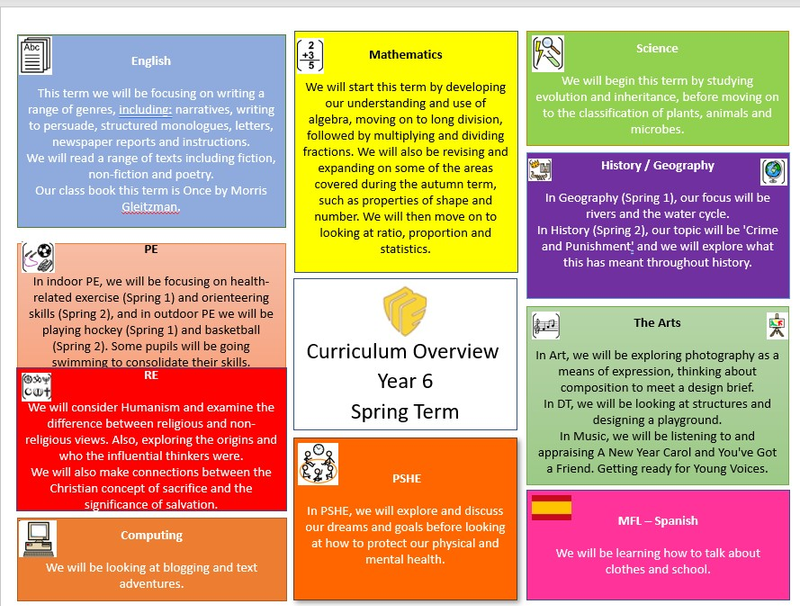
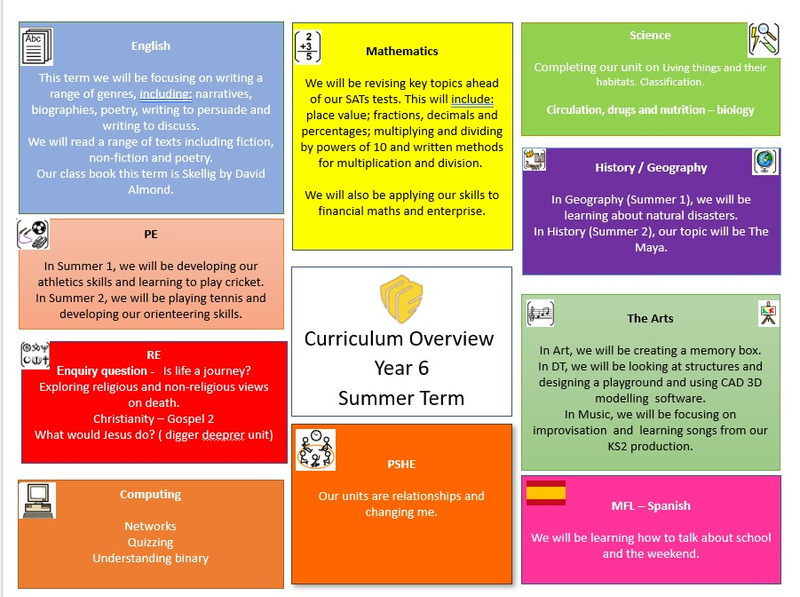
Please see below for the documents sent out to parents at the beginning of each term. They outline the term ahead and how parents can support at home.
Autumn Term Curriculum Map

Spring Term Curriculum Map
Summer Term Curriculum Map

English is Year 6
In Year 6, our English curriculum is designed to inspire confident, thoughtful, and skilled communicators. Using the HFL Education Writing Essentials, we place a strong focus on crafting high-quality writing through clear purpose, audience awareness, and precise language choices. Pupils build on prior learning to develop greater control over grammar, vocabulary, and structure, allowing them to write with increasing fluency and sophistication.
Across a range of engaging texts and genres, children explore rich language models that support both reading comprehension and writing development. They are encouraged to plan, draft, revise, and edit their work effectively—reflecting the HFL principle of writing as a process. Through purposeful talk and collaboration, pupils also develop their spoken language skills, deepening their understanding and ability to communicate ideas clearly.
By the end of Year 6, our aim is for every child to leave primary school as a confident, articulate writer, ready to meet the challenges of Key Stage 3 and beyond.
Please find a recommended reading list from 'The School Reading List' here. It includes some brilliant books which are age appropriate and there will be something for everyone on the list. It is important that the children read a range of genre and authors to support them with their writing for style and engagement. However, ultimately, we want our children to have a love of reading.
Maths in Year 6
In Year 6, all children are expected to build on the mathematical foundations they have developed in earlier years. The focus is on consolidating key skills and deepening their understanding, preparing them for secondary school. Key areas of learning include:
-
Number and Place Value: Pupils should be confident with numbers up to 10 million, understanding place value, and comparing and ordering numbers. They will also learn to round numbers to any given place value and solve problems involving these concepts.
-
Addition, Subtraction, Multiplication, and Division: Year 6 students are expected to perform calculations with large numbers, using all four operations. This includes solving multi-step word problems, as well as applying efficient methods for both mental and written calculations.
-
Fractions, Decimals, and Percentages: Pupils will deepen their understanding of fractions by adding, subtracting, multiplying, and dividing fractions, including those with different denominators. They will also convert between fractions, decimals, and percentages and solve problems involving percentages.
-
Algebra: Pupils will be introduced to algebra, focusing on simple equations and finding unknown values. This is a foundational skill for secondary school maths.
-
Measurement: Students will learn to convert between different units of measurement, including length, mass, volume, and time. They will solve problems involving perimeter, area, and volume, using appropriate formulae.
-
Geometry: In Year 6, pupils explore the properties of 2D and 3D shapes, including calculating the area and volume of shapes, and understanding angles, symmetry, and translations.
-
Statistics: Pupils will work with data by interpreting and creating graphs, including bar charts, line graphs, and pie charts. They will calculate averages and use data to solve problems.
Throughout the year, students will also be encouraged to develop problem-solving skills, logical thinking, and resilience in tackling complex challenges.
The Year 6 curriculum is designed to ensure that pupils are confident, capable mathematicians, fully prepared for the transition to secondary school and beyond.


